Human Factors
for RPAS
Why Pilots Make Mistakes & How to Prevent Them
Based on TP15263 Section 3 & Transport Canada Standards
CASARA Training - April 23, 2026 (60-90 min)
Why This Matters
- 75-80% Pilot error = all aviation accidents
This isn't about bad pilots. It's about systems. Humans are predictable in certain ways. - RPAs are no different
Drone pilots face same cognitive limitations. You're looking at a screen, not out a windshield. - Human factors training reduces risk
Not by making you superhuman. By making you aware of your limits. - Your brain is both your best tool and biggest liability
Same brain that got you here can also kill you. Know which mode it's in.
Learning Objectives (TP15263)
By the end of this session, you will be able to:
- Describe visual scanning techniques for collision avoidance
- Explain factors affecting pilot alertness & decision-making
- Identify signs of fatigue, stress, and impairment
- Apply the Swiss Cheese Model to accident analysis
- Recognize automation complacency risks
The Visual System
Vision is our PRIMARY sensory system for flight
Key factors affecting visual performance:
- Visual acuity (20/20 normal, contrast matters)
A drone against grey sky is hard to see - Accommodation & convergence (eye focus adjustments)
Eyes adjust from controller screen to sky (~1-2 seconds) - Light/dark adaptation (takes longer dark→light)
Flying into shadow/cloud = compromised vision - Empty space myopia (focuses at 1m in empty sky)
Solution: Actively focus at distance, use horizon/clouds as reference
Visual Scanning Techniques
Effective collision avoidance scanning:
- Series of regularly spaced eye movements
Methodical beats frantic - Focus for at least 1 second on each block area
Minimum time for brain to register detail - Systematic pattern: outer edge → aircraft → outer edge → aircraft → controller
Fixed pattern prevents missing areas. Pilots with IFR training will be familiar with this - this is your RPAS T-scan. - For VOs: scan in strips, pause at each fixation
- ⚠ Perspective illusion: Distant aircraft appear slower/smaller than reality
That Cessna 2 miles out? It's doing 120mph. Looks like it's crawling.
Orientation & Disorientation
Visual illusions are a leading cause of accidents
Common illusion scenarios:
- Sloping terrain (looks different than it is)
- Lighting intensity changes (clouds, sun position)
- Lack of surface texture (water, snow, empty fields)
No reference points = can't judge altitude or movement - Approach path confusion
Mitigation: Altitude caps, altitude minimums, GPS altitude, collision avoidance cameras
Your eyes lie. Instruments don't. Trust the numbers, verify with eyes.
Body Rhythms & Fatigue
Circadian rhythm = 24-hour cycle
- Controlled by light/dark, meals, activity
Your body has a clock. Fighting it = fighting biology - Disruption = degraded performance
Shift work, jet lag, all-nighters = same impairment as being drunk
Jet lag effects:
- Slowed reaction time 24hr awake = 0.10% BAC
- Decision-making impairment
- Memory issues
- Accepting lower performance standards
Sleep Deprivation
Adults need 7-9 hours sleep
Sleep is restorative and essential for mental performance
Rules (CAR 901.19):
- 12 hours - No flying within 12 hours of consuming alcohol
- No flying while fatigued
- No flying while impaired by medications
Warning signs:
Microsleeps (brief blackout) • Slowed reactions (delayed inputs) • Poor judgment (thinking you're fine)
Medications & Substances
ANY medication can impair performance
- Over-the-counter: antihistamines, analgesics
First-gen antihistamines (Benadryl) = strong sedation - Prescription: check with medical examiner
- Even "safe" drugs can have residual effects
Half-life matters. Took at 10pm? Still in you at 6am - The 5x Half-Life Rule:
Look up medication's half-life → multiply by 5 = wait time - Example: 8hr half-life × 5 = 40 hours
- Long-term use = builds up, may need longer
⚠ Never self-medicate before flying
Alcohol
Depressant of the nervous system
- Slows everything: reflexes, judgment, vision
Depressant of nervous system affects all cognitive functions - Disrupts sleep patterns (hangover effect)
Sleep drunk is still drunk - 12 hours - rule is MINIMUM
Some need 24. Know your body - Removed at fixed rate - can't be sped up
Strong coffee doesn't help. Time is the only cure
A hangover is an effect of consuming alcohol
If you have to ask if it's been long enough, it hasn't
Aviation Psychology
Factors affecting decision-making:
- Stress (acute vs chronic)
Acute = "there's a plane" (focuses). Chronic = "bills, life" (distracts) - Workload management
Too much = overwhelmed. Too little = bored. Both dangerous - Situational awareness
Knowing what's around you, where you are, what's coming - Attitude (overconfidence, complacency)
"I've done this 100 times" = dangerous phrase
The dangerous triad:
Fatigue + Stress + Complacency
All three together = accident waiting to happen
Situational Awareness
The ability to perceive, comprehend, and project
- Perceive
What's around me right now? - Comprehend
What does it mean? - Project
What's going to happen next?
Lost when:
- High workload
- Distractions
- Information overload
- Fatigue
Maintain SA through:
Systematic scanning • Verbal callouts • Crew communication • Cross-checking instruments
Automation Complacency
"The automation did it" is a dangerous mindset
You're still the pilot. The machine is a tool, not a replacement
Risks:
- Skills atrophy (lost manual flying ability)
If automation fails, can you fly manually? - Reduced vigilance ("It's watching, so I don't have to")
- Mode confusion (What mode is it in? What will it do next?)
- Automation surprises ("Why did it do THAT?")
Mitigation:
Know your automation intimately • Stay engaged • Practice manual flying regularly
The Swiss Cheese Model
James Reason's accident causation model
Four layers of defense (each layer should stop the accident):
- 1. Organizational - Policies, culture, resources
HQ decisions, training programs, funding - 2. Supervision - Training, mentoring, oversight
Did someone check your work? - 3. Preconditions - Fatigue, equipment, crew state
What's your condition? - 4. Unsafe Acts - Errors, violations, mistakes
The actual mistake
Accident = holes align across all layers
One hole = blocked. Four holes in a line = accident.
Swiss Cheese Model
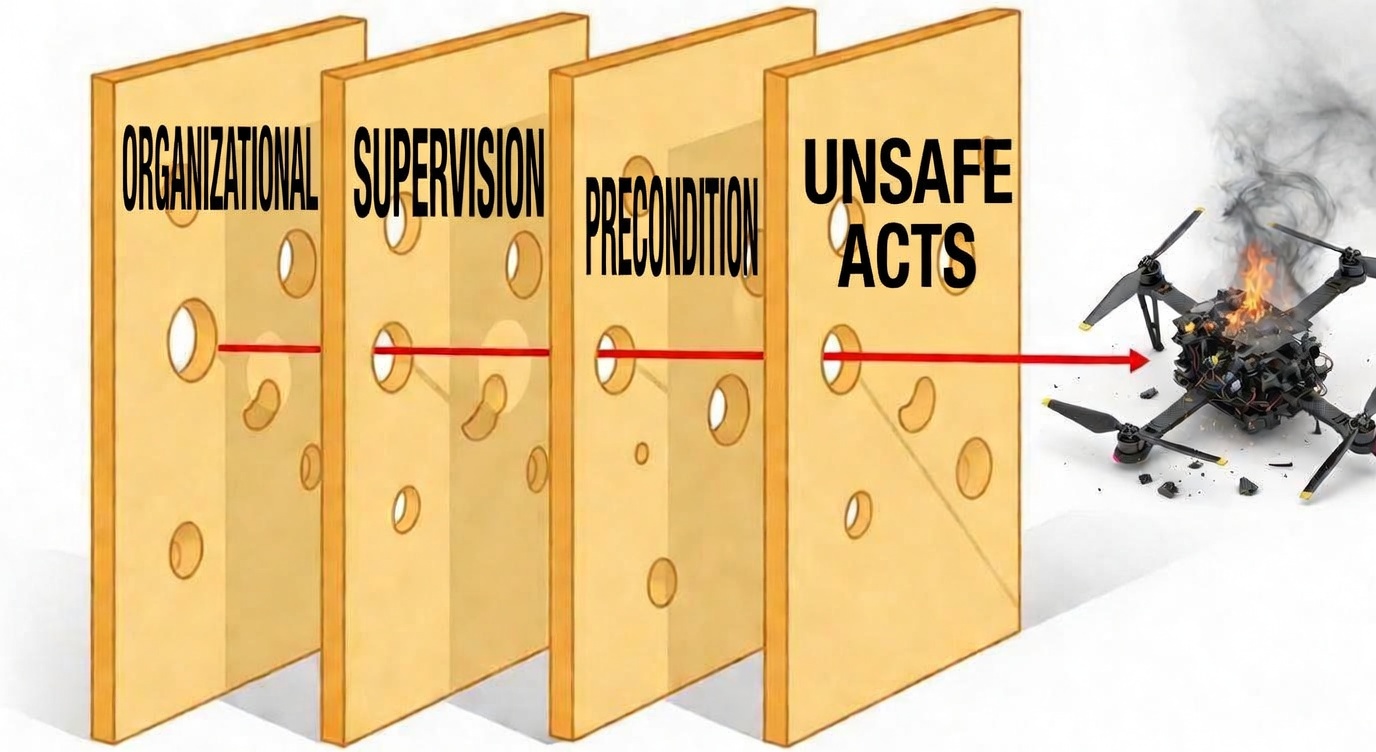
When holes align across all layers → accident penetrates all defenses
HFACS Framework
Human Factors Analysis & Classification System
Expands Swiss Cheese into:
- Organizational Influences
Management, policies, culture, resource allocation - Unsafe Supervision
Inadequate supervision, planned inappropriate operations - Preconditions for Unsafe Acts
Personal factors (fatigue, stress), environmental factors - Unsafe Acts (errors/violations)
Skill-based errors, decision errors, routine violations
Used by TSB, FAA, Transport Canada
This is the professional standard
Case Study - TSB A21O0069
The Buttonville Collision
Real accident. Real report. Real lessons.
August 10, 2021
- York Regional Police DJI Matrice M210
Professional unit, not hobbyists - Cessna 172 on final to CYKZ
Landing traffic - RPA hovering at 400ft AGL
Below cloud, in approach path - COLLISION - no injuries
Lucky. Could have been fatalities
Why this matters: Same situation could happen in SAR.
You vs manned aircraft. Who wins? Nobody.
Case Analysis - What Happened?
Timeline:
- 1256: RPA begins 2nd flight, hovers at 400ft
"Just a hover" = dangerous assumption - 1257: Cessna joins right downwind Runway 15
Aircraft joining = traffic pattern - 1301: Collision at 1.2NM from threshold
5 minutes later. Lots of time to see it
The pilot was:
- Watching video feed (not airspace)
GCS screen = his back to the sky - Had ADS-B receiver but Cessna had no ADS-B
Technology failed. Doesn't replace looking - No dedicated spotter assigned
Second set of eyes could have seen it
Apply Swiss Cheese
1. ORGANIZATIONAL:
• Police unit requested recon under approach path
• No policy against hover location
2. SUPERVISION:
• No dedicated spotter
• Officer commanding stood nearby watching video
3. PRECONDITIONS:
• RPA pilot watching screen, not airspace
• Cessna no ADS-B (invisible to RPA)
• TV display lacked telemetry
4. UNSAFE ACTS:
• Hovering in active approach path
• Cessna see-and-avoid failed
Discussion
Questions for the class:
- Which layer had the most critical failure?
- What could have prevented this?
- How does this apply to CASARA operations?
Think about your own operations:
• Where are the holes in your cheese?
• What's your "video feed" distraction?
The 12 Core Human Factors
- 1. Fatigue - The killer. Most under-reported
- 2. Stress - "Hurry up" kills
- 3. Complacency - "It'll be fine"
- 4. Lack of Knowledge - Don't know what you don't know
- 5. Distraction - Focused on one thing, miss everything else
- 6. Situational Awareness - Lost SA = lost control
- 7. Communication - "I thought you said..."
- 8. Pressure - Mission completion > safety = wrong
- 9. Norms - "It's always been fine before"
- 10. Lack of Resources - Doing more with less = accident
- 11. Attitude - "It won't happen to me"
- 12. Fitness - Can you actually do this today?
Exercise - Scenario Analysis
Scenario: You're tasked with a search pattern near an airport. The operation commander keeps changing the search area. You're on your 3rd battery, tired, and haven't eaten. The weather is deteriorating.
Apply Swiss Cheese - identify failures in each layer:
- Organizational: No clear search area, changing demands
- Supervision: No one saying "stop, we're done"
- Preconditions: Fatigue (3rd battery), hunger, weather
- Unsafe Acts: Continuing when you should have landed
Key Takeaways
- 1. Pilot error is #1 cause - understand why
It's not about bad pilots. It's about systems - 2. Fatigue kills - know your limits
If you have to ask, you shouldn't fly - 3. Automation is a tool - do not trust blindly
Can fail. Can be misunderstood. You're still pilot - 4. SOPs exist - they are written in blood
Someone died so that rule exists - 5. Swiss Cheese works - use it for analysis
Not just for accidents - use for pre-flight "what could go wrong" - 6. You are the last line of defense
Everyone else can fail. You're there at the end
Resources
- TP15263 Section 3 - Human Factors (Transport Canada)
Your syllabus - CAR 901.19 - Personnel Licensing & Operations
The rules - TSB A21O0069 - Buttonville Collision Report
Read it. It's public. - CASARA Spotters Guide
Your visual scanning reference - HFACS Framework (Scott Shappell)
The academic stuff behind Swiss Cheese
Questions?
- Discussion
- Scenarios
- Real-world applications
Stay safe. Fly smart.